


STATE RESIN IDENTIFICATION REGULATION SURVEY
2025
This information is provided in good faith and is believed to be reliable when written. The Plastics Industry Association assumes no liability whatsoever for the accurately or completeness of the information contained herein. It does not constitute legal advice.
State Resin Identification Regulatory Survey
September 2025
The Society of the Plastics Industry (SPI), now the Plastics Industry Association (PLASTICS), developed a voluntary resin identification coding system in 1988 at the urging of recyclers around the country. From the outset the system was designed to facilitate visual sortation, with the use of the chasing arrows to distinguish it from existing marks put on rigid plastic containers used by manufacturers in processing and identification. The SPI resin identification code (RIC) was not, and never was intended, to be an indicator of “recyclability”. The original standard required the code to be permanently affixed to any plastic container to identify
the resin from which the container is produced during the molding process. In 2008, SPI transferred the management of the RIC to ASTM International. A revision of the code was then adopted which included several changes, including updating the symbols themselves to use an equilateral triangle.
Many states have passed legislation requiring the marking of plastic products. PLASTICS performed a survey of state regulations for the labeling of plastic products to better understand the landscape of state requirements and their conflicts. PLASTICS supports a national standard for the identification of plastic products to ensure consistency and clarity.
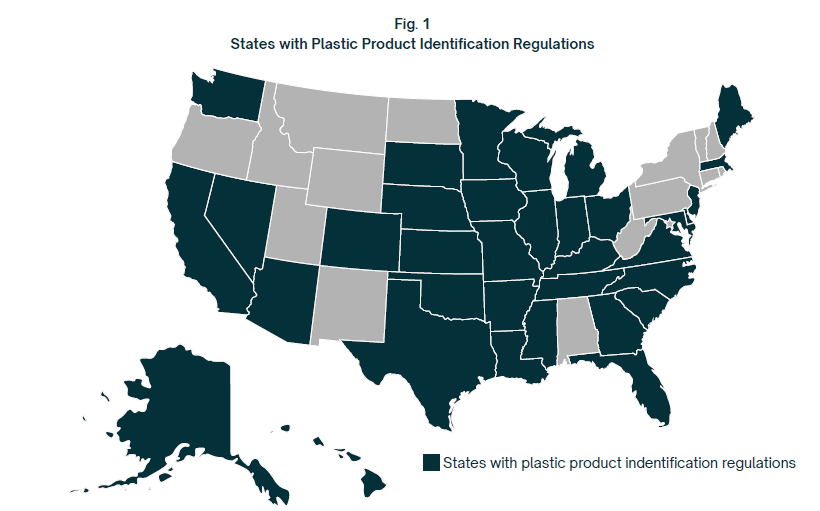
Plastic product identification is or was required in 40 states. 36 states currently require at least some plastic products have some form of identification of the primary resin type used (Fig 1). 31 states require this identification on only plastic bottles or rigid plastic packaging, with 15 states further narrowing the scope of bottles or packages of a specific size. 29 states require a symbol which includes a chasing arrow. A table of states with existing identification requirements is attached as Appendix A.
The RIC and State Recycling Labeling Laws
Packaging and products often come with claims about how they are made, what they are made of, and the options for waste management. Primarily, this area of law has been managed by the federal government, specifically the Federal Trade Commission and the Environmental Protection Agency.
A recent development in state labeling laws is to classify the chasing arrows in conjunction with the RIC as making marketing claims for post-use material management. States are requiring proof of certain material management pathways if producers are using a chasing arrows symbol which they have determined suggests claims about the recyclability of a product. This is counter to the federal interpretation found in the FTC Green Guides.1 States regulating marketing claims and labeling laws adds a new layer to the compliance concerns for companies.
While this was previously considered in other states, California is the first to venture into this area of law, with the enactment of SB 343 (See Appendix B). The legislation puts the onus on producers to understand the recyclability performance of their products in the state and ensure that their products do not inappropriately (in the state of California) make an unsubstantiated claims via the use of chasing arrows as part of their RIC. If producers fail to comply with this legislation, there is a possibility of criminal penalties. Following California’s SB 343, many other states continue to introduce similar legislation. There are bills introduced for the 2025 legislative session in New York and Massachusetts. Appendix B show the current enacted legislation and introduced and active bills across the states dealing with recyclable marketing claims.
1 “If the manufacturer places the RIC, without more, in an inconspicuous location on the container (e.g., embedded in the bottom of the container), it would not constitute a recyclable claim.” Guides for the Use of Environmental Marketing Claims (Green Guides), Federal Trade Commission, 16 C.F.R. Part 260 (2012).
Appendix A. Plastic Product Identification Regulations by State
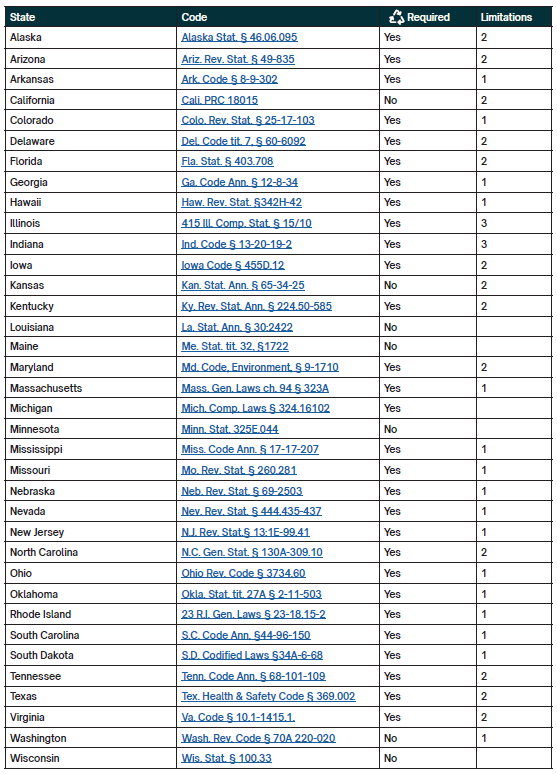
1. Applicable to plastic bottles and rigid plastic packaging
2. Applicable to plastic bottles between 16 fluid ounces and not more that 5 gallons and rigid plastic packaging between 8 fluid ounces and 5 gallons.
3. Applicable to plastic bottles larger than 16 fluid ounces and rigid plastic packaging great than 8 fluid ounces.
Appendix B. Plastic Product Identification Regulations by State
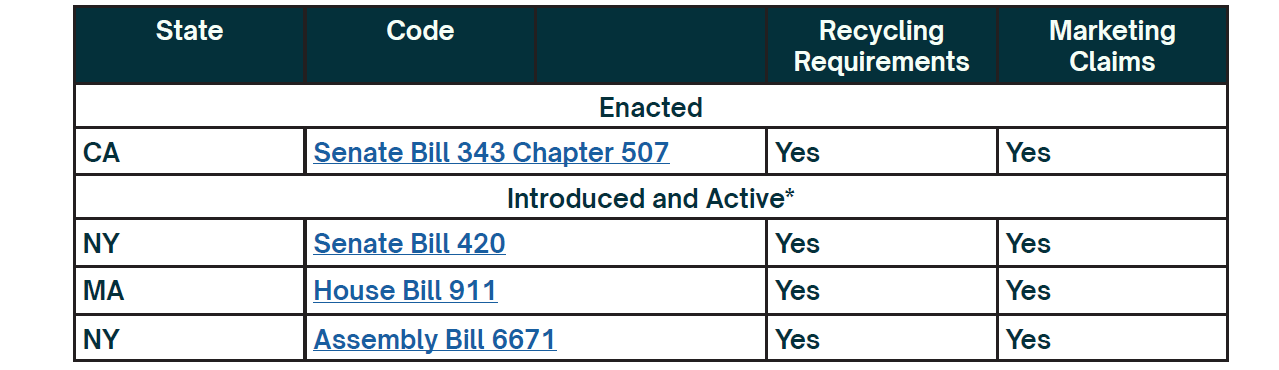
*Bills in this category have been introduced to their respective legislatures and they are actively considering the bill within the current session. The bills may or may not move forward to become laws during the session.
PLASTICS is tracking these bills and will continue to provide updates as their statuses change.